
When Does a Cough Need a Nebulizer? What Patients Should Know

Written by Dr. Michael Brooks, Cardiovascular & Chronic Disease Content Specialist
Reviewed for medical accuracy under the Ivermectinkart Editorial Policy
Introduction
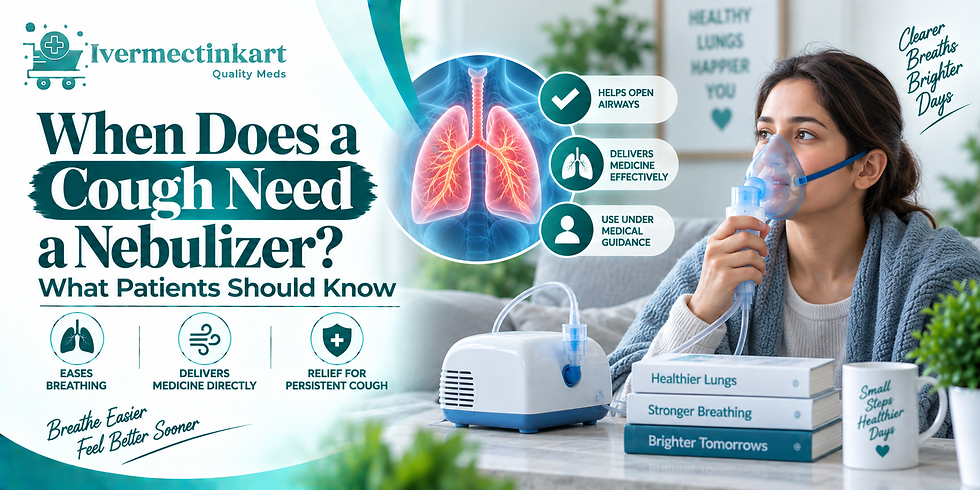
A cough can be uncomfortable and persistent, but coughing by itself does not usually mean you need a nebulizer. A nebulizer is a medicine-delivery device that turns prescribed liquid medication into a mist, allowing it to be inhaled into the lungs. Whether it helps depends mainly on what is causing the cough, not simply how often or how loudly you are coughing. So, when does a cough need a nebulizer? It may be appropriate when coughing occurs with an airway condition such as asthma or COPD and a clinician has determined that nebulized medication is needed, particularly when significant airway narrowing or difficulty using another inhaler is involved. Most uncomplicated coughs caused by colds or acute bronchitis do not benefit from routine bronchodilator or corticosteroid treatment. This guide explains when nebulization may help, when it probably will not, which symptoms matter, and when coughing needs medical assessment instead of another breathing treatment.
Does Every Bad Cough Need a Nebulizer?
No. A severe-sounding or persistent cough does not automatically need nebulization because a nebulizer treats certain underlying airway problems; it does not simply “switch off” the cough reflex.
Acute cough is commonly associated with a viral upper respiratory infection or acute bronchitis and usually improves without specialized inhaled treatment. NICE advises that an acute cough is generally self-limiting and commonly settles within three to four weeks.
The NICE guidance on treating acute cough specifically recommends against offering an inhaled or oral bronchodilator such as salbutamol for an uncomplicated acute cough or acute bronchitis unless the person has an underlying airways disease such as asthma.
That distinction is important. A nebulizer may be useful when there is a treatable problem in the lower airways, but simply putting medicine into a nebulizer does not make it an appropriate cough treatment.
What exactly does a nebulizer do?
A nebulizer converts liquid medication into an aerosol that you breathe through a mouthpiece or mask. The device is only the delivery system—the medicine inside determines the treatment effect.
For example, a nebulized bronchodilator may relax tightened airway muscles. A nebulized corticosteroid has a different purpose, helping control airway inflammation in specific conditions.
This means nebulizer treatment should begin with the question, “What is causing the cough?” rather than “Which respule should I use?”
When Can a Cough Benefit From Nebulizer Treatment?
A nebulizer may be appropriate when coughing is part of a diagnosed respiratory condition requiring inhaled medication and nebulization is an appropriate way to deliver it. Asthma and COPD are common examples, but the diagnosis, medicine and device all need to match.
Cough with asthma and wheezing
Asthma can cause coughing along with wheezing, breathlessness and chest tightness. Some people—particularly children—may have cough as a prominent symptom, although cough alone does not prove that someone has asthma.
When airway muscles tighten during asthma symptoms, an appropriate bronchodilator can help open the airways. Salbutamol, also called albuterol in some countries, is one such bronchodilator.
The NHS information about salbutamol explains that salbutamol can relieve asthma and COPD symptoms including coughing, wheezing and breathlessness by relaxing airway muscles. It can be delivered by nebulizer in selected circumstances, although an inhaler is commonly used.
Importantly, a nebulizer is not automatically necessary simply because asthma is causing the cough. The appropriate medicine and delivery device depend on the severity of symptoms, the treatment plan and whether the person can effectively use an alternative inhaler device.
Cough during a COPD flare-up
COPD can cause chronic coughing, mucus production, wheezing and breathlessness. During a COPD exacerbation, or flare-up, these symptoms can become worse than usual.
Nebulized bronchodilator treatment may sometimes be appropriate, particularly in more severe disease or when inhalers are insufficient or difficult to use effectively.
For stable COPD, however, nebulizers are not automatically preferable. NICE recommends considering nebulized therapy for people with distressing or disabling breathlessness despite maximal inhaler treatment and confirming that nebulization actually provides benefit.
When using an inhaler is difficult
Sometimes the reason for choosing a nebulizer is not the diagnosis itself but difficulty using another delivery device.
The American Lung Association's guide to nebulizer use notes that nebulizers may be recommended for people who have difficulty using inhalers because of health problems or cannot inhale deeply enough for other devices.
This can matter for some people with severe respiratory disease, physical limitations or difficulty coordinating inhaler use. Before switching devices, however, clinicians may also consider whether an alternative inhaler or spacer could solve the problem.
Types of cough and whether a nebulizer is usually considered
Situation | Is a nebulizer routinely needed? | Why? |
Common cold with cough | Usually no | Nebulized bronchodilators do not routinely treat an uncomplicated viral cough |
Acute bronchitis without underlying airway disease | Usually no | Bronchodilators are not routinely recommended |
Asthma with bronchospasm | Sometimes | Prescribed inhaled medicine may be needed to open narrowed airways |
COPD with significant breathlessness or exacerbation | Sometimes | Nebulized bronchodilators may be appropriate in selected situations |
Chronic unexplained cough | Not automatically | The underlying cause needs investigation |
Cough with severe breathing difficulty | Needs urgent assessment | Emergency treatment may involve more than nebulization |
A nebulizer treats a condition behind the cough—not the sound or intensity of the cough itself. Wheezing, airway narrowing, an established respiratory diagnosis and the person's ability to use an inhaler are generally more relevant to nebulizer decisions than coughing alone.
Which Nebulizer Medicines Might Be Used When Someone Is Coughing?
The correct medicine depends entirely on the cause of the respiratory symptoms. Nebulizer medicines should therefore not be selected simply according to whether a cough is dry, wet, severe or occurring at night.
Bronchodilators
Medicines such as salbutamol/albuterol are bronchodilators. They relax muscles surrounding the airways, which can make breathing easier when bronchospasm is present.
This explains why someone experiencing an asthma exacerbation may benefit from prescribed bronchodilator treatment while someone coughing because of an uncomplicated cold may not.
Evidence reviewed by NICE found that beta-2 agonist bronchodilators generally did not improve cough symptoms in people with acute cough or acute bronchitis without underlying airway disease and increased adverse effects such as tremor.
Inhaled corticosteroids
Corticosteroids reduce airway inflammation. Budesonide, for example, is available as nebulizer liquid in some markets.
But a corticosteroid respule should not be treated as a general-purpose cough medicine. In asthma, inhaled corticosteroids may form part of the treatment used to control inflammatory airway disease.
Their purpose is fundamentally different from quickly relaxing airway muscles with a bronchodilator.
The NHS notes that nebulized budesonide needs regular use to produce its intended controller effect and does not work immediately.
What about normal saline?
Nebulized saline has uses in particular respiratory circumstances, but patients should not assume that saline nebulization is necessary for an ordinary cough or that it treats the underlying cause.
Similarly, adding medicines, essential oils, homemade salt solutions or other substances to a nebulizer without appropriate instructions can be unsafe. Only solutions specifically intended for the device and recommended for the individual situation should be used.
What to do—and what not to do—when considering a nebulizer for cough
Do | Don't |
Identify the likely cause of persistent or significant coughing | Assume every cough needs nebulization |
Follow the prescribed respiratory treatment plan | Use someone else's nebulizer medicine |
Check the medicine name and strength before treatment | Choose a respule based only on packaging or color |
Use the nebulizer exactly as instructed | Increase nebulizer frequency independently when breathing worsens |
Clean and dry equipment according to manufacturer instructions | Put essential oils or unapproved liquids into the medicine chamber |
Seek assessment when symptoms are worsening | Keep repeating home nebulization while serious breathing symptoms deteriorate |
Why Might a Nebulizer Not Help a Dry or Mucus-Producing Cough?
Because “dry” and “wet” describe the cough rather than identify its cause. Two people with similar-sounding coughs may have completely different conditions and therefore need completely different treatment.
A dry cough might occur with a viral infection, asthma, allergies, reflux, environmental irritation, certain medications or other conditions. A cough producing mucus can occur with respiratory infections, COPD, bronchiectasis and several other illnesses.
Nebulization is therefore not selected simply according to whether mucus is present.
What if the cough is from a cold or bronchitis?
Most acute coughs are caused by viral upper respiratory infections or acute bronchitis and improve naturally. NICE advises that bronchodilators and corticosteroids should not routinely be offered for an acute cough unless an underlying airways disease such as asthma is present.
That recommendation helps prevent unnecessary treatment and avoid medication adverse effects.
It also explains why feeling temporary moisture from a nebulizer should not be confused with treating the cause of the illness.
What if the cough lasts for weeks?
A persistent cough needs investigation rather than automatically escalating nebulizer treatment.
Possible causes include asthma, COPD, upper-airway problems, gastroesophageal reflux, medication effects and other respiratory conditions. The American Lung Association similarly emphasizes that treatment for chronic cough depends on identifying the underlying cause.
A clinician may need to ask about smoking or vaping, medicines, allergies, occupational exposures, infections, wheezing, mucus, reflux and other symptoms. Depending on the situation, examination, lung-function testing or imaging may be appropriate.
Is a Nebulizer Better Than an Inhaler for Cough and Wheezing?
Not automatically. A nebulizer can make medication easier to inhale in some situations, but it does not inherently make the medicine more powerful or make every respiratory symptom respond better.
Nebulizers allow medication to be inhaled during repeated normal breaths. Treatment also tends to take longer than using a handheld inhaler.
An appropriately selected inhaler can be highly effective when used correctly. A spacer can also make medication from certain metered-dose inhalers easier to deliver.
When does the device itself become important?
A clinician may consider whether the person:
can coordinate an inhaler correctly;
can generate the inhalation required by the chosen device;
has physical or cognitive limitations affecting technique;
needs a medicine available in nebulized form;
has severe symptoms requiring acute treatment; or
has demonstrated better symptom control with appropriately prescribed nebulized therapy.
For COPD specifically, NICE recommends assessing the person's or caregiver's ability to use nebulized treatment and confirming meaningful improvement before continuing it long term.
Nebulizer technique also matters. The medicine cup, mouthpiece or mask needs appropriate cleaning because contaminated equipment can become another health risk. The American Lung Association recommends cleaning relevant nebulizer components after use and following manufacturer instructions for more thorough disinfection.
What Should You Do Before Using a Nebulizer for a Cough?
First establish whether the nebulizer and its medicine were prescribed or recommended for the condition causing your symptoms. Do not assume that a previous nebulizer prescription remains appropriate for a new cough.
Check the active ingredient and strength of every respule or nebulizer solution before use. Medicines that come in similar-looking plastic containers can have very different functions.
If you already have asthma or COPD, follow your individualized treatment or action plan. Pay particular attention to instructions explaining what to do when coughing, wheezing or breathlessness increases.
If the prescribed rescue medicine is needed increasingly often, provides less relief than usual or symptoms return quickly, contact a healthcare professional rather than simply continuing additional treatments indefinitely.
People without an established airway condition should be particularly cautious about self-starting nebulized bronchodilators or corticosteroids for an ordinary cough. NICE specifically advises against these medicines for uncomplicated acute cough in people without underlying airway disease.
When Does a Cough Need Urgent Medical Attention?
A cough needs urgent assessment when it occurs with signs that breathing or general health is seriously affected. In these circumstances, deciding whether to use a nebulizer should not delay appropriate medical care.
Seek urgent or emergency medical help for severe or rapidly worsening breathing difficulty, bluish or grey discoloration of the lips or skin, marked drowsiness or confusion, coughing up significant blood, severe chest pain, or other signs of serious illness.
People with asthma or COPD should also seek appropriate medical help when their prescribed rescue treatment is not providing the expected relief or their symptoms are substantially worse than usual.
The NICE acute-cough safety guidance advises medical reassessment when symptoms worsen rapidly or significantly, the person becomes systemically very unwell, or an acute cough does not improve within the expected three-to-four-week period.
A nebulizer is a treatment-delivery device, not an emergency safety net. Serious pneumonia, pulmonary embolism, severe asthma and other potentially dangerous causes of cough and breathlessness require medical assessment and may need treatment well beyond nebulization.
Conclusion
So, when does a cough need a nebulizer? Usually when the cough is part of a respiratory condition for which a specific inhaled medicine is appropriate and nebulization is a suitable way to deliver it—not simply because the cough is severe, dry, wet or persistent. Asthma, COPD and significant bronchospasm are situations in which nebulized medicines may sometimes have a role, while uncomplicated viral coughs generally do not require them.
Use nebulizer medicines only as directed for the diagnosed condition. If coughing is persistent, rapidly worsening, associated with significant breathlessness or not responding to prescribed respiratory treatment, seek medical assessment rather than repeatedly self-treating with a nebulizer.
Frequently Asked Questions
1 . Can I use a nebulizer just because I have a bad cough?
Usually not. A nebulizer delivers medication for a particular respiratory problem rather than treating every type of cough. If you do not have a diagnosed condition or prescribed nebulizer treatment, the cause of a severe or persistent cough should be assessed first.
2 . Does a dry cough need nebulization?
Not simply because it is dry. Dry coughing can result from infections, asthma, allergies, reflux, irritants, medicines and other causes. Nebulization may help only when the underlying condition responds to a medicine appropriately delivered through a nebulizer.
3 . Does a cough with mucus need a nebulizer?
Not automatically. Mucus can occur with viral infections, COPD and several other respiratory conditions, and treatment depends on the cause. A nebulizer should not be used merely to “clear mucus” unless an appropriate nebulized treatment has been recommended for the underlying condition.
4 . Can salbutamol nebulization stop a cough?
Salbutamol may improve coughing associated with bronchospasm because it relaxes airway muscles, but it is not a general cough medicine. NICE does not recommend bronchodilators for uncomplicated acute cough or bronchitis in people without underlying airway disease such as asthma.
5 . Is nebulized budesonide useful for every persistent cough?
No. Budesonide is an inhaled corticosteroid used for particular inflammatory airway conditions and should not be treated as a general remedy for persistent coughing. A cough lasting several weeks deserves evaluation so treatment can target its actual cause.
6 . When should I see a doctor instead of continuing nebulization?
Seek medical advice when symptoms are worsening, prescribed rescue treatment is becoming less effective, or coughing persists beyond the expected illness. Severe breathlessness, blue or grey lips or skin, confusion, significant coughing of blood or severe chest symptoms require urgent medical attention.


Comments