
HCG Injections 2,000 IU vs 5,000 IU: What the Strengths Mean, Medical Uses & Safety

Written by Dr. Olivia Bennett, Senior Oncology & Clinical Research Content Specialist
Reviewed for medical accuracy under the Ivermectinkart Editorial Policy
Introduction
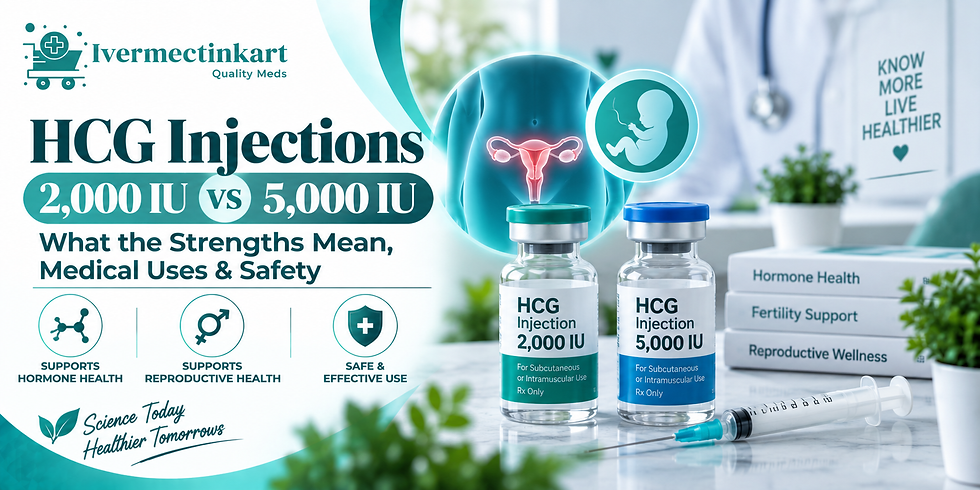
Human chorionic gonadotropin, usually shortened to hCG or HCG, is a hormone used medically in certain fertility and hormone-related treatments. When comparing HCG injections 2,000 IU vs 5,000 IU, the numbers describe biological activity in International Units (IU), not simply how “strong” the medicine feels or how effective it will be. A 5,000 IU amount contains 2.5 times the measured biological activity of 2,000 IU, but that does not make it the better choice for every patient or purpose. HCG acts similarly to luteinizing hormone (LH), a natural hormone involved in ovulation and testosterone production. Its medical use varies considerably between female fertility treatment and selected hormonal conditions in males. This guide explains what these IU strengths mean, where hCG is medically used, why doses cannot simply be compared as “low versus high,” and the safety issues patients should understand.
What Does IU Mean on an HCG Injection?
IU stands for International Unit, a standardized way of expressing the biological activity of certain medicines and biological substances. For hCG, an IU therefore measures activity rather than the medicine's weight in milligrams.
The distinction matters because hCG products may be supplied as a powder that must be mixed with a specified diluent before injection. The amount of liquid used for reconstitution affects the resulting concentration in IU per millilitre, but it does not change how many total IU were originally contained in the vial.
For example, current U.S. labeling for one chorionic gonadotropin product shows that a 5,000 IU vial can produce different IU-per-millilitre concentrations depending on the approved reconstitution volume. Patients should therefore follow the instructions for their exact product rather than converting IU into millilitres themselves.
2,000 IU and 5,000 IU describe quantities of hCG biological activity. They are not universal prescriptions: the dose actually administered, treatment schedule, reconstitution instructions, and clinical purpose can differ substantially.
HCG 2,000 IU vs 5,000 IU: What Is the Difference?
Numerically, 5,000 IU contains 2.5 times as many International Units as 2,000 IU. Clinically, however, this does not mean that everyone receiving hCG should move from 2,000 IU to 5,000 IU for a “stronger” effect.
The appropriate amount depends on why hCG is being prescribed and on the specific treatment protocol. Current prescribing information includes different regimens across male hormonal treatment, fertility treatment, and other approved indications.
HCG 2,000 IU and 5,000 IU compared
Feature | 2,000 IU | 5,000 IU |
What the number represents | 2,000 International Units of hCG activity | 5,000 International Units of hCG activity |
Relative amount | Lower total IU | 2.5 times the IU of 2,000 IU |
Does the strength determine the medical use by itself? | No | No |
Can it appear in a medical regimen? | Yes, in certain protocols | Yes, including some fertility and other labeled protocols |
Is it automatically the safer option? | No | No |
Is it automatically more effective? | No | No |
Should patients choose between them themselves? | No; use should follow the prescribed regimen | No; use should follow the prescribed regimen |
The distinction between vial strength and administered dose is also important. A vial containing a particular total number of IU does not necessarily tell you how much a patient should receive at one time. Product formulation and reconstitution instructions must also be considered.
How Does HCG Work in the Body?
HCG acts in ways that closely resemble luteinizing hormone. Its effects therefore differ between ovaries and testes.
How HCG works in female fertility treatment
During a normal menstrual cycle, an LH surge helps trigger ovulation. HCG can activate the same LH/hCG receptor and can therefore be used as a signal for final egg maturation and ovulation in appropriately managed fertility treatment.
This usually occurs after earlier fertility medicines have stimulated follicle development. Ultrasound and sometimes hormone measurements are used to assess the ovarian response before the trigger is given.
How HCG works in males
In males, hCG stimulates Leydig cells in the testes, encouraging production of androgens such as testosterone. This is why hCG has medical applications in selected cases of hypogonadotropic hypogonadism, where insufficient signalling from the brain and pituitary gland results in inadequate stimulation of the testes.
Treatment goals and schedules in this setting differ greatly from the one-time trigger approach commonly associated with fertility treatment in women.
What Are HCG Injections Medically Used For?
Medical uses depend on the product, patient, diagnosis, and country-specific authorization. HCG should therefore be understood as a prescription hormone medicine rather than a general-purpose hormone supplement.
Ovulation induction and fertility treatment
HCG can be used to induce final follicular maturation and ovulation after appropriate ovarian stimulation. The American Society for Reproductive Medicine describes urinary hCG doses of 5,000–10,000 IU as options for triggering ovulation in gonadotropin-treated anovulatory women, with ovulation expected roughly 36–48 hours after the trigger.
The ASRM guidance on gonadotropin ovulation induction also emphasizes monitoring because ovarian stimulation can produce multiple developing follicles and increase the risks of multiple pregnancy and ovarian hyperstimulation syndrome (OHSS).
In assisted reproductive technology, hCG can similarly be used for final follicular maturation before egg retrieval. Specific protocols vary, and other triggering strategies may be used in some patients.
Hypogonadotropic hypogonadism in males
HCG is also indicated in selected males with hypogonadotropic hypogonadism. In this condition, inadequate pituitary stimulation can result in low testicular hormone production and impaired reproductive function.
U.S. chorionic gonadotropin labeling includes several historical treatment regimens, including one in which 4,000 IU is followed later by 2,000 IU at specified intervals. This demonstrates why seeing “2,000 IU” on a treatment plan cannot be interpreted without knowing the diagnosis, stage of therapy, and prescribed schedule.
Cryptorchidism in selected pediatric cases
Some U.S. hCG labels also include prepubertal cryptorchidism—an undescended testicle not caused by an anatomical obstruction—as an indication. The labeling contains several possible regimens rather than one universal dose.
Clinical practice and recommendations can differ by country and over time, so this use requires specialist pediatric assessment rather than dose selection based on vial strength alone.
Is 5,000 IU HCG Better Than 2,000 IU?
No universal “better” strength exists. A 5,000 IU amount provides more hCG activity than 2,000 IU, but the clinically appropriate amount depends on the treatment objective, protocol, individual response, and relevant safety considerations.
This becomes particularly important during fertility treatment. ASRM guidance describes 5,000–10,000 IU urinary hCG for an ovulation trigger in a particular gonadotropin-treatment context, while U.S. labeling for male hypogonadotropic hypogonadism contains entirely different dosing patterns.
In other words, a dose that makes sense for one indication should not be copied into another.
More hCG is also not necessarily associated with better fertility outcomes. The ASRM guideline on preventing ovarian hyperstimulation syndrome reviews studies of lower versus higher hCG trigger doses and notes that research has not shown a simple, consistent dose-response relationship that allows patients to choose a dose based solely on the number of IU.
Why an HCG dose may differ between patients and treatment plans
Factor | Why it matters |
Reason for treatment | Fertility treatment and male hormonal treatment have different goals |
Treatment protocol | HCG may be a single trigger or part of a longer regimen |
Ovarian response | Follicle number and response can influence fertility-treatment decisions |
Other fertility medicines | HCG may follow prior ovarian stimulation |
Individual risk | Excessive ovarian response can make an hCG trigger inappropriate |
Product formulation | Vial strength, concentration after reconstitution, and instructions can differ |
Country and product labeling | Approved indications and instructions are not identical everywhere |
Why Should HCG Not Be Used for Weight Loss or Bodybuilding?
HCG has acquired uses outside conventional medical indications, particularly in weight-loss programs and bodybuilding or performance-enhancement settings. These uses should not be confused with established indications in prescription labeling.
Current U.S. prescribing information explicitly states that hCG has not been demonstrated to be effective as an additional treatment for obesity. The labeling states there is no substantial evidence that it increases weight loss beyond calorie restriction or changes body-fat distribution.
Similarly, using hCG without appropriate medical assessment to manipulate testosterone or recover from anabolic steroid use is different from medically supervised treatment of diagnosed hypogonadotropic hypogonadism. A genuine endocrine or fertility problem requires investigation of its underlying cause rather than self-selecting an hCG dose.
What Are the Side Effects and Safety Risks of HCG Injections?
HCG is a biologically active prescription hormone, and its risks depend partly on the patient and treatment setting. Reported adverse effects include headache, fatigue, irritability, restlessness, fluid retention, breast enlargement in males, and injection-site pain. Hypersensitivity reactions have also been reported.
Ovarian hyperstimulation syndrome
One of the most important fertility-related complications is ovarian hyperstimulation syndrome, or OHSS. The ovaries can become enlarged and fluid can shift into other parts of the body; severe cases can become medically serious.
HCG's relatively prolonged stimulation of the LH receptor contributes to its relationship with OHSS. Fertility specialists therefore monitor ovarian response and may change or withhold an hCG trigger when the response is excessive.
Multiple pregnancy and other serious risks
Gonadotropin fertility treatment can increase the likelihood of multiple ovulation and multiple pregnancy. U.S. hCG labeling also warns about ovarian cyst rupture and thromboembolic complications in the fertility-treatment setting.
Reconstitution and storage matter too
Some hCG products are supplied as freeze-dried powder and require reconstitution. Instructions are product-specific: for example, current U.S. products differ in how long a reconstituted solution may be refrigerated before disposal.
This is why patients should use the supplied diluent and follow the exact storage, preparation, injection, and disposal instructions for their prescribed brand. Instructions from a different hCG product should not automatically be substituted.
Seek urgent medical care during fertility treatment for severe or rapidly worsening abdominal or pelvic pain, marked abdominal swelling, difficulty breathing, faintness, significantly reduced urination, or other severe symptoms. Possible allergic reactions such as facial or throat swelling or breathing difficulty also require urgent assessment.
Conclusion
When comparing HCG injections 2,000 IU vs 5,000 IU, the central point is that IU measures biological activity—not which option is universally better. A 5,000 IU amount contains more hCG activity, but hCG dosing varies substantially between fertility treatment, selected male hormonal disorders, and other authorized uses. The prescribed dose also needs to be understood alongside its timing, frequency, formulation, and reconstitution instructions.
HCG should be used under qualified medical supervision because inappropriate treatment can cause important hormonal and fertility-related complications. If you have been prescribed hCG, confirm the exact product, IU dose, mixing instructions, injection schedule, and storage requirements with your prescriber or pharmacist before use.
Frequently Asked Questions
1 . Is 5,000 IU of HCG stronger than 2,000 IU?
Yes, in terms of measured biological activity: 5,000 IU contains 2.5 times the IU of 2,000 IU. That does not mean it is automatically more effective or appropriate. HCG dosing depends on the medical indication and treatment protocol.
2 . What does 2,000 IU mean on an HCG injection?
It means the stated amount contains 2,000 International Units of hCG biological activity. IU should not be treated as a direct measure of injection volume. The concentration in IU per millilitre depends on the particular product and, when applicable, how it is reconstituted.
3 . Is 5,000 IU HCG used to trigger ovulation?
Yes, 5,000 IU of urinary hCG is used in some medically supervised ovulation-induction protocols. ASRM guidance describes 5,000–10,000 IU as trigger options in a specific gonadotropin-treatment setting. The actual trigger strategy depends on ovarian response and the fertility protocol.
4 . Can men be prescribed 2,000 IU HCG?
Yes, 2,000 IU appears within some labeled regimens for selected cases of male hypogonadotropic hypogonadism. That does not make 2,000 IU a standard dose for every man with low testosterone or infertility. The underlying diagnosis and treatment plan matter.
5 . Can HCG injections be used for weight loss?
HCG is not supported as an effective weight-loss treatment. U.S. prescribing information states there is no substantial evidence that it increases weight loss beyond calorie restriction or changes body-fat distribution. Using prescription hCG specifically for weight loss should not be confused with its established medical indications.
6 . Can I change from 2,000 IU to 5,000 IU HCG myself?
No. Changing from 2,000 IU to 5,000 IU substantially changes the amount of biological activity administered and may alter treatment effects and risks. Use the dose and schedule prescribed for your particular diagnosis, product, and treatment protocol.


Comments