
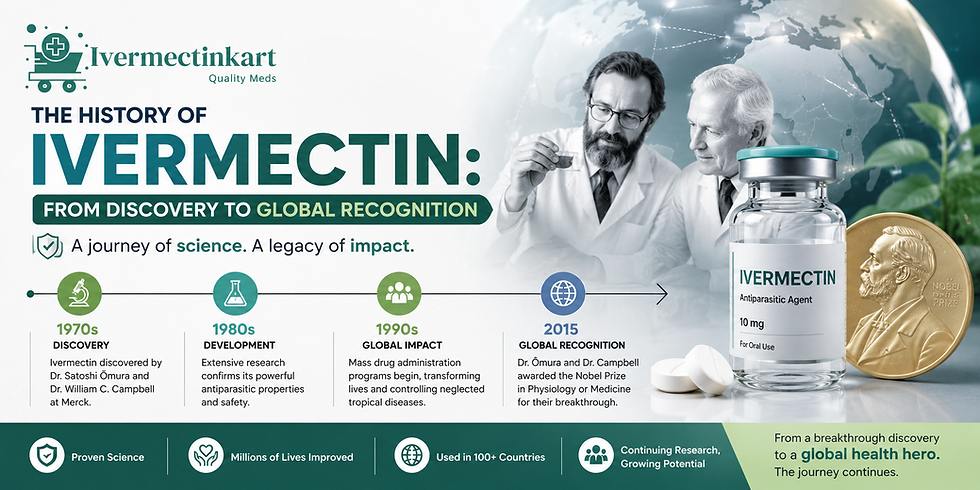
The History of Ivermectin: From Discovery to Global Recognition

The History of Ivermectin began with a scientific search for new medicines hidden in nature. What started as research on soil bacteria eventually led to the development of a drug that has helped millions of people and animals around the world. Few medicines have had such a far-reaching impact on public health.
Before ivermectin was introduced, parasitic diseases affected entire communities across Africa, Asia, and Latin America. Many infections caused long-term disability, blindness, and reduced quality of life. Scientists were actively searching for safer and more effective treatments.
The discovery of ivermectin changed the fight against parasitic diseases and became one of the most important medical achievements of the twentieth century. Its story continues to inspire researchers, healthcare professionals, and public health organizations worldwide.
What Is Ivermectin?
Ivermectin is a medicine used to treat certain infections caused by parasites. It belongs to a class of medications known as antiparasitic drugs and has been used in healthcare for several decades.
The medication works by affecting the nervous system of specific parasites. This prevents them from functioning normally and helps eliminate them from the body. Its effectiveness made it an important advancement in parasite control.
Today, ivermectin continues to be used for approved medical and veterinary purposes and remains one of the best-known antiparasitic medicines in the world.
The Global Need for Better Parasite Treatments
Before the development of ivermectin, many parasitic diseases were difficult to control. Existing treatments often had limitations related to effectiveness, accessibility, or safety.
Millions of people lived with infections that affected their health, ability to work, education, and overall quality of life. In many developing regions, parasitic diseases remained a major public health challenge.
Researchers understood that finding new treatments could dramatically improve health outcomes for affected populations. This need drove scientists to search for promising compounds from natural sources.
The Discovery That Started Everything
The story of ivermectin began with the study of microorganisms found in soil. Scientists believed that bacteria living in nature might produce compounds capable of treating disease.
Researchers collected thousands of soil samples from different environments and carefully analyzed them in laboratories. Their goal was to identify microorganisms with unique biological properties.
One particular microorganism would eventually lead to a discovery that changed global healthcare forever.
Satoshi Ōmura's Groundbreaking Research
Japanese scientist Satoshi Ōmura played a central role in the early discovery process. He specialized in identifying microorganisms that could produce medically useful compounds.
His research focused on finding rare bacterial strains with unique biological activity.
Key contributions included:
Collecting thousands of soil samples
Isolating promising microorganisms
Studying bacterial characteristics
Identifying valuable strains
Supporting future drug research
Discovery of Streptomyces avermitilis
Among the many microorganisms studied, one species stood out because of its unusual properties. It was later named Streptomyces avermitilis.
Scientists discovered that this bacterium produced compounds with remarkable antiparasitic activity.
Important findings included:
Strong activity against parasites
Unique biological properties
Potential medical applications
Broad research opportunities
Foundation for future drug development
International Collaboration and Drug Development
Scientific discoveries often become successful because researchers work together. The development of ivermectin is a powerful example of international collaboration.
After identifying the promising microorganism, researchers continued investigating its compounds and their effects on parasites. Their combined efforts helped transform laboratory findings into a practical medicine.
William C. Campbell's Contribution
Researcher William C. Campbell and his colleagues played a major role in evaluating the compounds produced by the microorganism.
Their work focused on understanding how these substances could be used to combat parasitic infections.
Major contributions included:
Testing antiparasitic effectiveness
Studying biological mechanisms
Evaluating treatment potential
Supporting drug development
Advancing medical research
Development of
The active compounds isolated from the microorganism became known as avermectins. These compounds demonstrated impressive results during research studies.
Scientists recognized that avermectins could become the basis for a highly effective antiparasitic medicine.
Development steps included:
Compound isolation
Laboratory testing
Safety assessments
Activity evaluations
Preparation for refinement
From Avermectins to Ivermectin
Researchers continued improving avermectins to create a medicine that offered even greater effectiveness and safety. Through scientific refinement, ivermectin was developed.
This process required years of research, testing, and evaluation. Scientists carefully studied how the medication worked and how it could be used safely.
The final result was a medicine that would become one of the most successful antiparasitic treatments ever developed.
Timeline of Major Milestones
The history of ivermectin spans decades of scientific achievement.
Year | Milestone | Significance |
Early 1970s | Soil microorganism identified | Beginning of research |
Mid-1970s | Avermectins discovered | Major scientific breakthrough |
Late 1970s | Drug development advances | Preparation for practical use |
1981 | Veterinary launch | Success in animal healthcare |
Late 1980s | Human health programs expand | Public health impact grows |
1990s–2000s | Global disease-control efforts | Millions receive treatment |
2015 | Nobel Prize awarded | International recognition |
Present Day | Continued approved use | Ongoing healthcare importance |
Success in Veterinary Medicine
Before widespread human use, ivermectin achieved major success in veterinary medicine. Farmers and veterinarians quickly adopted it because of its effectiveness against many parasites affecting animals.
Parasitic infections can reduce animal health, productivity, and welfare. Effective treatment helped improve outcomes for livestock and companion animals alike.
Its veterinary success demonstrated the drug's value and encouraged further development for human healthcare applications.
Transforming Human Healthcare
The introduction of ivermectin into human medicine marked a turning point in the fight against parasitic diseases. Public health experts recognized its potential to improve lives on a large scale.
The medication became particularly important in areas where parasitic diseases were widespread and healthcare resources were limited.
Its impact extended beyond individual patients and contributed to major international health initiatives.
River Blindness Control
River blindness, or onchocerciasis, affected millions of people and was a leading cause of preventable blindness in some regions.
Ivermectin helped support large-scale disease-control efforts.
Benefits included:
Reduced disease transmission
Improved quality of life
Better community health
Prevention of complications
Support for elimination programs
Lymphatic Filariasis Programs
Ivermectin also became part of strategies aimed at controlling lymphatic filariasis.
Public health programs used the medication alongside other interventions to reduce disease burden.
Program goals included:
Lower infection rates
Expanded treatment access
Community protection
Improved health outcomes
Support for elimination efforts
Global Recognition and Nobel Prize Achievement
As evidence of ivermectin's impact grew, the scientific community increasingly recognized its importance. The medication became a symbol of how research can improve global health.
Its success demonstrated that discoveries from natural sources can lead to life-changing medical advances.
Nobel Prize Recognition in 2015
In 2015, Satoshi Ōmura and William C. Campbell received the Nobel Prize in Physiology or Medicine for discoveries related to avermectin-derived therapies.
The award recognized:
Scientific innovation
Public health impact
Medical advancement
Global benefits
Lasting contribution to humanity
Ivermectin's Legacy Today
Today, ivermectin remains an important medicine for approved uses in both human and veterinary healthcare. It continues to be recognized as one of the most successful antiparasitic drugs ever developed.
Researchers still study its history because it provides valuable lessons about drug discovery, scientific collaboration, and public health innovation.
Its legacy extends beyond medicine and serves as an example of how scientific curiosity can create lasting global benefits.
Lessons Learned from the Ivermectin Story
The history of ivermectin teaches several important lessons about medical innovation. Major breakthroughs often begin with basic scientific research and years of dedicated investigation.
The story also highlights the importance of international partnerships. Scientists from different countries worked together to solve a major healthcare challenge.
Most importantly, ivermectin demonstrates how investment in science can improve millions of lives and contribute to global health progress.
Conclusion
The history of ivermectin is a remarkable journey from a soil microorganism to global medical recognition. Through scientific dedication, international collaboration, and years of research, ivermectin became one of the most important antiparasitic medicines in healthcare history.
Its impact on both human and animal health has been substantial, helping control parasitic diseases and improving public health outcomes around the world. The recognition of its discovery through the Nobel Prize further highlights its significance.
As medicine continues to advance, the story of ivermectin remains a powerful reminder of the value of scientific research and its ability to create lasting benefits for society.


FAQs
Q1. Who discovered ivermectin?
Ivermectin was developed through the work of Satoshi Ōmura and William C. Campbell and their research teams.
Q2. What was ivermectin originally created for?
It was developed as an antiparasitic medicine to treat infections caused by parasites.
Q3. Why is ivermectin important in medical history?
It significantly improved the treatment and control of several parasitic diseases affecting millions of people.
Q4. When did ivermectin receive Nobel Prize recognition?
The related discovery received Nobel Prize recognition in 2015.
Q5. Is ivermectin used in veterinary medicine?
Yes. It remains widely used to treat parasitic infections in animals.
Q6. Why is the history of ivermectin still relevant today?
It demonstrates how scientific research and global collaboration can lead to major healthcare breakthroughs.



Comments