
Hormonal vs Non-Hormonal Birth Control: Which Is Better for You?

Updated: Sep 24
Written by Dr. Charles Drew, Lead Pharmaceutical Content Specialist & Clinical Drug Information Reviewer
Reviewed for medical accuracy under the Ivermectinkart Editorial Policy
Introduction
When comparing hormonal vs non-hormonal birth control, there is no single method that is better for everyone. The right choice depends on how strongly you want to prevent pregnancy, your health history, whether you want hormones, how you feel about changes to your periods, how much day-to-day effort you prefer, and whether you need protection from sexually transmitted infections (STIs). Hormonal options include pills, patches, vaginal rings, injections, implants, and hormonal IUDs, while non-hormonal choices include the copper IUD, condoms, diaphragms, spermicides, and fertility-awareness methods. Some hormonal methods can make periods lighter or less painful, while a hormone-free option may better match other people's preferences or medical circumstances. Effectiveness varies more by the individual method than by whether it is hormonal or non-hormonal. This guide compares the major options available in the United States so you can understand the trade-offs before discussing contraception with a health care professional
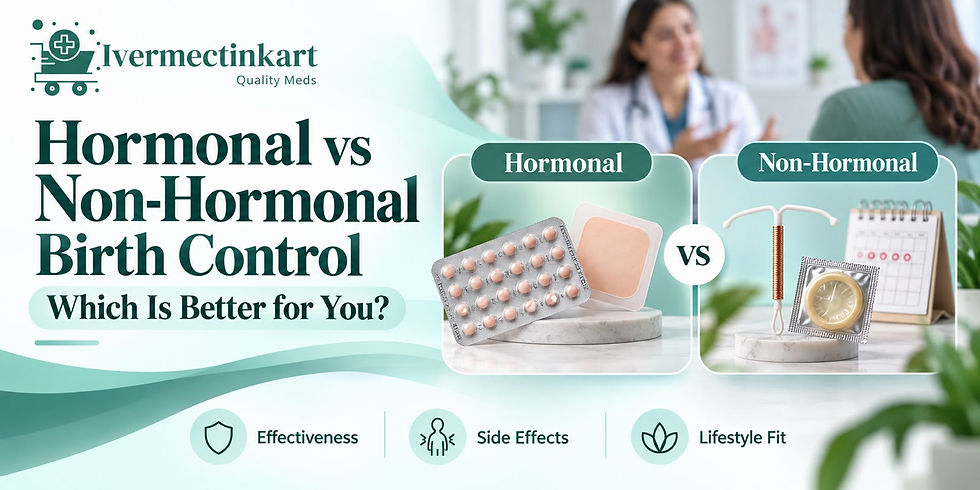
What Is the Difference Between Hormonal and Non-Hormonal Birth Control?
Hormonal birth control uses progestin alone or progestin combined with estrogen to prevent pregnancy.
Depending on the method, these hormones may stop ovulation, thicken cervical mucus so sperm have difficulty reaching an egg, and cause other changes that reduce the chance of pregnancy.
Non-hormonal contraception prevents pregnancy without estrogen or progestin. However, these methods do not all work in the same way.
For example, the copper IUD interferes with sperm's ability to move normally, making fertilization less likely. Condoms provide a physical barrier, while fertility-awareness methods identify fertile days so unprotected vaginal sex can be avoided during those times.
Which Methods Contain Hormones?
Hormonal contraceptives include:
Combined birth control pills
Progestin-only pills
Birth control patches
Vaginal rings
Contraceptive injections
Birth control implants
Hormonal IUDs
Importantly, hormonal methods are not interchangeable. A combined pill containing estrogen and progestin has different medical considerations from a progestin-only implant or hormonal IUD.
Which Methods Are Hormone-Free?
Common non-hormonal options include:
Copper IUD
External and internal condoms
Diaphragms
Cervical caps
Spermicides
Vaginal pH modulators
Fertility-awareness methods
These options range from long-acting contraception that requires almost no ongoing effort to methods that need attention every time you have sex or throughout each menstrual cycle.
“Non-hormonal” does not mean less effective, and “hormonal” does not automatically mean more effective. The copper IUD is hormone-free yet highly effective, while both hormonal IUDs and the hormonal implant are also among the most effective reversible methods.
How Effective Are Hormonal vs Non-Hormonal Birth Control Methods?
Effectiveness depends more on the specific method and how consistently it is used than on whether it contains hormones. IUDs and implants are especially effective because, once placed, they do not depend on remembering contraception every day or every time you have sex.
The CDC overview of contraception and birth control methods reports typical-use failure rates of about 0.1% for the implant, 4% for the injection, and 7% for combined and progestin-only pills.
For IUDs, fewer than 1 user out of 100 becomes pregnant during the first year with typical use.
Practical comparison of common hormonal and non-hormonal birth control methods
Method | Hormonal? | Typical Use | Main Practical Consideration |
Implant | Yes | Fewer than 1 pregnancy per 100 users in first year | Long-acting; little ongoing effort |
Hormonal IUD | Yes | Fewer than 1 pregnancy per 100 users in first year | Long-acting; may reduce menstrual bleeding |
Copper IUD | No | Fewer than 1 pregnancy per 100 users in first year | Long-acting and hormone-free |
Injection | Yes | About 4 pregnancies per 100 users in first year | Must be repeated on schedule |
Birth control pill | Yes | About 7 pregnancies per 100 users in first year | Requires regular pill-taking |
External condom | No | Less effective for pregnancy prevention than IUDs/implant | Used each time; also reduces STI risk |
Standard Days Method | No | About 13 pregnancies per 100 users in first year | Requires cycle tracking and avoiding unprotected sex on fertile days |
These figures describe population-level typical use rather than an individual's guaranteed chance of pregnancy. Real-world effectiveness can be affected by whether a method is used correctly and consistently.
What Are the Benefits and Drawbacks of Hormonal Birth Control?
Hormonal birth control can combine effective pregnancy prevention with benefits such as changes in menstrual bleeding or pain. The main drawbacks are potential side effects and the fact that certain hormonal formulations are not medically appropriate for everyone.
What Are the Potential Benefits?
Depending on the method, possible benefits include:
Highly effective pregnancy prevention
Less menstrual bleeding
Reduced menstrual cramps
Fewer or no periods with some methods
Long-term protection with hormonal IUDs and implants
No need to interrupt sex to use contraception
Reversibility when pregnancy is desired later
For example, hormonal IUDs commonly decrease menstrual bleeding and menstrual pain over time. Some users eventually stop having menstrual bleeding while the IUD is in place.
Hormonal contraception can therefore be useful for reasons beyond simply preventing pregnancy.
However, these additional effects depend on the specific method and individual response.
What Side Effects Can Occur?
Side effects vary between methods. Changes in bleeding patterns are particularly common with hormonal contraception.
Depending on the contraceptive, people may experience irregular bleeding, headaches, nausea, breast tenderness, acne, or other effects. The implant, for example, commonly causes unpredictable bleeding patterns.
Not every symptom experienced while taking contraception is necessarily caused by the contraceptive. If a side effect is persistent, troublesome, or unexpected, discussing it with a clinician can help determine whether changing the method makes sense.
Who May Need to Avoid Certain Hormonal Methods?
This question requires an important distinction: being unable to use estrogen does not necessarily mean being unable to use all hormonal birth control.
The pill, patch, and vaginal ring are available as combined hormonal contraceptives containing estrogen and progestin. Certain health conditions can make these methods inappropriate even when some progestin-only options remain acceptable.
For example, the CDC classifies combined hormonal contraception as an unacceptable health risk for people with migraine with aura. Smoking also changes eligibility: for people aged 35 or older, combined oral contraceptive use becomes increasingly restricted according to the amount smoked because of cardiovascular risks.
The CDC U.S. Medical Eligibility Criteria for Contraceptive Use provides method-specific guidance covering cardiovascular conditions, migraine, cancer, postpartum circumstances, medication interactions, and numerous other health considerations.
What Are the Benefits and Drawbacks of Non-Hormonal Birth Control?
Non-hormonal birth control avoids contraceptive hormones, but that alone does not make it safer, more effective, or more suitable for everyone. The advantages and disadvantages depend heavily on which non-hormonal method you choose.
Why Might You Prefer a Non-Hormonal Method?
Someone might consider non-hormonal contraception because they:
Prefer not to use contraceptive hormones
Have experienced unwanted effects with a hormonal method
Have medical circumstances that limit certain hormonal choices
Want contraception only when having sex
Want a long-acting hormone-free option
Want condoms for STI risk reduction
Prefer fertility-awareness approaches
The copper IUD is particularly different from other non-hormonal choices. It provides highly effective, long-acting contraception without requiring daily action.
What Are the Possible Disadvantages?
Hormone-free does not mean side-effect-free. The copper IUD, for example, can increase menstrual bleeding and pain, particularly during the first months after insertion.
Other non-hormonal methods can require substantially more participation from the user. Condoms must be used correctly each time, while fertility-awareness methods require ongoing attention to the menstrual cycle and avoiding unprotected intercourse during fertile periods.
The trade-off therefore depends on what matters most to you: convenience, effectiveness, menstrual effects, hormone exposure, STI protection, or control over when contraception is used.
Hormonal vs Non-Hormonal Birth Control: How Do the Trade-Offs Compare?
Neither hormonal nor non-hormonal birth control wins in every category. A more useful comparison looks at individual methods and the features that matter to you.
The FDA specifically notes that no single contraceptive product is best for everyone. Health, future pregnancy plans, sexual activity, partners, and access to particular methods can all influence contraceptive choice.
Hormonal vs non-hormonal birth control at a glance
What Matters to You? | Hormonal Options | Non-Hormonal Options |
Avoiding hormones | No | Yes |
Highly effective long-term option | Hormonal IUD or implant | Copper IUD |
Lighter periods | Some methods may reduce bleeding | Copper IUD may increase bleeding initially |
Reduced menstrual cramps | Possible with some methods | Not a general benefit |
Daily option | Birth control pills | Fertility tracking may require daily attention |
Used only around sex | Generally no | Condoms and some barrier methods |
STI risk reduction | Hormonal methods do not protect against STIs | Condoms reduce STI risk when used correctly |
Requires clinician placement | IUD and implant | Copper IUD; some barrier methods require fitting |
Reversible options | Yes | Yes |
Appropriate for everyone | No | No |
The FDA guide to birth control options provides U.S.-specific information about available contraceptive products, effectiveness, and important risks and considerations.
How Can You Choose the Right Birth Control for You?
The better choice is the method that fits your priorities, health, reproductive plans, and ability to use it consistently. Instead of beginning with “hormonal or non-hormonal?”, it may be more useful to ask what you need your contraception to accomplish.
Consider these questions:
How important is highly effective pregnancy prevention? If avoiding pregnancy is a major priority, long-acting methods such as IUDs and implants offer very high effectiveness with little ongoing effort.
Do you want to avoid hormones? If yes, the copper IUD and barrier or fertility-awareness methods provide hormone-free alternatives with very different effectiveness and convenience profiles.
What are your periods currently like? Someone with heavy or painful periods may value the potential bleeding benefits of certain hormonal methods, while the possibility of heavier periods with a copper IUD may be an important consideration.
Will remembering contraception be difficult? A daily pill or method used during every sexual encounter requires more consistent action than an IUD or implant.
Do you want pregnancy in the future? Many hormonal and non-hormonal methods are reversible. IUDs and implants can be removed when contraception is no longer wanted.
Do you need STI protection? Hormonal contraceptives and IUDs do not protect against STIs. Consistent and correct external latex condom use reduces STI risk, including HIV risk.
Do you have health conditions or take regular medication? Your medical history can change which contraceptive methods are appropriate.
The ACOG birth control guidance for patients emphasizes considering effectiveness, ease of use, side effects, future pregnancy plans, STI protection, and health problems when selecting contraception.
When Should You Talk With a Health Care Professional?
A clinician can help you compare birth control methods when you have a medical condition, take prescription medicines or supplements, experience heavy or painful periods, recently gave birth, are breastfeeding, or previously experienced troublesome contraceptive side effects.
Medical review is especially important when considering estrogen-containing contraception if you smoke and are 35 or older, experience migraine with aura, have a history of blood clots, or have certain cardiovascular or other medical conditions. CDC guidance evaluates these situations individually because restrictions differ substantially among combined hormonal contraceptives, progestin-only methods, and IUDs.
Contact a health care professional promptly if you develop severe or unexpected symptoms after starting contraception. Depending on the method and circumstances, symptoms such as sudden chest pain, difficulty breathing, new neurological symptoms, unusually severe headache, or severe abdominal or pelvic pain may require urgent assessment.
Conclusion
When considering hormonal vs non-hormonal birth control, focus on the individual method rather than assuming one category is better. Hormonal options can offer effective contraception and useful menstrual benefits, while non-hormonal choices include everything from condoms to the highly effective copper IUD. Effectiveness, health conditions, menstrual preferences, convenience, future pregnancy plans, and STI protection can all change which option fits your needs.
A U.S. health care professional can help you compare methods using your medical history and priorities. This article provides general education and does not replace individualized contraceptive or medical advice.
Frequently Asked Questions
1 . Is non-hormonal birth control safer than hormonal birth control?
Not automatically. Safety depends on the specific contraceptive and your medical history rather than simply whether it contains hormones. Certain people should avoid particular hormonal methods, while non-hormonal methods can have their own side effects, limitations, and medical considerations.
2 . What is the most effective non-hormonal birth control?
The copper IUD is one of the most effective reversible hormone-free methods. Fewer than 1 in 100 IUD users become pregnant during the first year with typical use. It provides long-term contraception without estrogen or progestin.
3 . Which birth control is best if I don't want hormones?
Options include the copper IUD, condoms, diaphragms, spermicides, and fertility-awareness methods. They differ substantially in effectiveness, convenience, side effects, and STI protection. Consider which features matter most to you and discuss suitable choices with a health care professional.
4 . Does hormonal birth control make periods lighter?
Some hormonal methods can reduce menstrual bleeding, but the effect depends on the method and the individual. Hormonal IUDs often reduce menstrual bleeding and pain over time, and bleeding may eventually stop in some users.
5 . Can I use hormonal birth control if I have migraines?
It depends on the migraine type and contraceptive. Under CDC guidance, combined hormonal contraception should not be used with migraine with aura because of unacceptable health risk, while other methods have different eligibility classifications. Discuss your migraine history with a clinician before choosing contraception.
6 . Which birth control methods also help protect against STIs?
Most contraceptive methods do not protect against STIs. Correct and consistent external latex condom use reduces the risk of STIs, including HIV, although it does not eliminate the risk completely. Condoms can also be used alongside another contraceptive method.


Comments