
Fenbendazole Research: Why Scientists Continue to Study It

Updated: 18/08/2026 | ⏱ 7 min read
Expert article by Dr. Charles drew, Lead Pharmaceutical Content Specialist
Medically reviewed by Ivermectinkart pharmacy on 18/08/2026
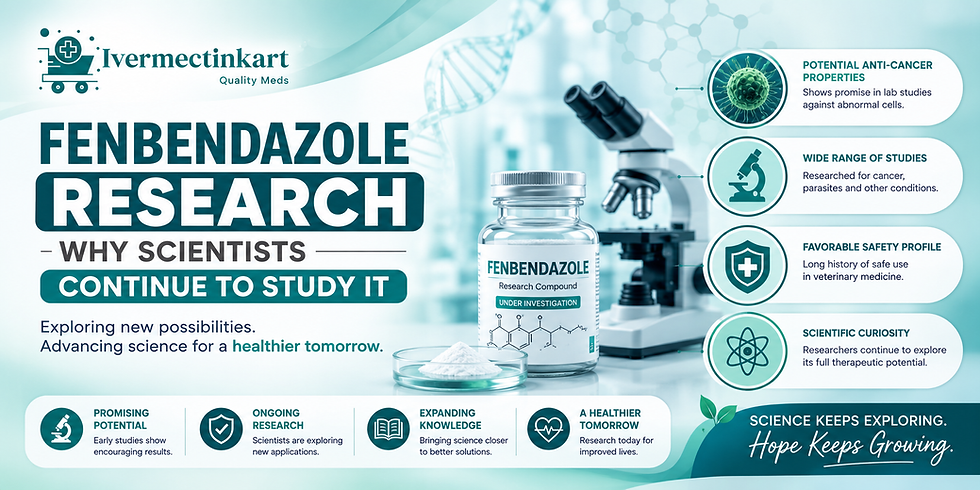
Fenbendazole Research continues to generate interest among scientists, healthcare observers, and individuals who follow developments in biomedical science. Originally developed as an antiparasitic medication for veterinary use, fenbendazole has been used for decades to help manage certain parasitic infections in animals. However, in recent years, researchers have explored additional biological properties that may warrant further scientific investigation.
Much of the attention surrounding fenbendazole stems from laboratory and preclinical studies examining how the compound interacts with cells and biological pathways. These investigations have raised important research questions, leading scientists to explore its mechanisms of action more closely.
At the same time, researchers emphasize that laboratory findings do not automatically translate into proven clinical benefits in humans.
As scientific understanding evolves, fenbendazole remains an area of active research. Understanding why scientists continue to study this compound can provide valuable insight into how medical discoveries are investigated, evaluated, and validated through evidence-based research.
What Is Fenbendazole?
Fenbendazole belongs to a class of compounds known as benzimidazoles. It has been widely used in veterinary medicine to help control certain parasitic infections in animals.
The medication works by disrupting important cellular processes within susceptible parasites, ultimately helping eliminate them from the host. Because of its effectiveness in veterinary settings, fenbendazole has been used for decades in various animal species.
Although its primary use remains parasite management in animals, researchers have explored whether its biological effects extend beyond antiparasitic activity.
Historical Background
Fenbendazole has a long history within veterinary medicine.
Key facts include:
Developed as an antiparasitic agent
Used in multiple animal species
Part of the benzimidazole drug family
Studied extensively in veterinary settings
Continues to be evaluated through research
Why Has Fenbendazole Attracted Scientific Interest?
Scientific interest in fenbendazole increased as researchers began examining its effects on cellular structures and biological pathways beyond parasite control.
Some laboratory studies suggested that fenbendazole may interact with mechanisms involved in cell division and cellular function. These observations encouraged additional investigations into how the compound behaves under different experimental conditions.
Researchers often explore existing compounds because understanding their biological activity may reveal new scientific insights or future research opportunities.
The Importance of Drug Repurposing Research
Scientists frequently investigate whether existing compounds have additional properties beyond their original purpose.
Potential advantages include:
Existing safety information
Known manufacturing processes
Lower research costs
Faster early-stage investigations
New scientific discoveries
Understanding How Scientific Research Works
Before discussing fenbendazole-specific studies, it is important to understand how medical research progresses. A laboratory finding alone does not prove that a treatment is effective or safe for human use.
Researchers typically move through several stages, beginning with laboratory experiments and progressing toward clinical trials if sufficient evidence exists.
This process helps ensure that scientific conclusions are based on reliable data rather than isolated observations.
Common Research Stages
Scientific investigation often includes:
Laboratory studies
Cell-based experiments
Preclinical research
Clinical trials
Regulatory review
Post-approval monitoring
What Have Laboratory Studies Investigated?
Many fenbendazole-related studies have focused on understanding how the compound interacts with cells in controlled laboratory environments.
Researchers use specialized techniques to observe cellular behavior, molecular interactions, and biological responses under experimental conditions.
These studies are designed to generate hypotheses and guide future research rather than establish clinical effectiveness.
Areas of Laboratory Investigation
Researchers have explored:
Cellular structure interactions
Molecular pathways
Cell division processes
Biological signaling mechanisms
Experimental therapeutic concepts
Fenbendazole and Cellular Mechanisms
One reason scientists continue studying fenbendazole is its interaction with structures known as microtubules. Microtubules play important roles in cell division, intracellular transport, and maintaining cell shape.
Understanding these interactions may help researchers better understand broader biological processes.
However, laboratory observations must be interpreted carefully because cellular behavior in experimental models may differ significantly from what occurs in living organisms.
Why Cellular Mechanisms Matter
Studying cellular mechanisms helps researchers:
Understand biological pathways
Identify research targets
Develop scientific hypotheses
Explore potential applications
Improve knowledge of disease processes
Areas of Ongoing Fenbendazole Research
Scientific interest in fenbendazole spans several research fields. Researchers continue investigating various questions related to its biological activity and potential mechanisms.
The table below summarizes some areas of active scientific exploration.
Research Area | Focus of Investigation |
Cellular Biology | Effects on cellular structures |
Molecular Research | Biological signaling pathways |
Drug Repurposing Studies | Potential alternative applications |
How compounds behave in biological systems | |
Safety Research | Understanding biological responses |
Experimental Models | Investigating mechanisms in controlled settings |
Why Laboratory Findings Require Caution
Laboratory studies are valuable, but they represent only one step in the scientific process. Results observed in cells or experimental models do not automatically predict outcomes in humans.
Many compounds show promising laboratory effects yet fail during later stages of research due to safety concerns, limited effectiveness, or biological differences.
Scientists emphasize the importance of rigorous testing before drawing conclusions about potential medical applications.
Common Limitations of Early Research
Researchers often consider:
Small study sizes
Experimental conditions
Biological differences
Limited clinical data
Need for replication
The Role of Clinical Trials
Clinical trials are necessary before determining whether a treatment is safe and effective for human use. These studies involve carefully monitored human participants and follow strict scientific and ethical guidelines.
For any compound being considered for new medical applications, clinical trials provide essential evidence regarding benefits, risks, and appropriate use.
Without sufficient clinical evidence, laboratory findings remain preliminary.
What Clinical Trials Evaluate
Researchers assess:
Safety
Effectiveness
Appropriate dosing
Side effects
Long-term outcomes
Challenges Researchers Face
Studying compounds like fenbendazole presents several scientific challenges. Researchers must determine whether laboratory findings are reproducible, biologically meaningful, and relevant to human health.
These investigations require time, funding, specialized expertise, and carefully designed studies.
Scientific progress often involves answering many questions before definitive conclusions can be reached.
Common Research Challenges
Scientists frequently encounter:
Complex biological systems
Funding limitations
Regulatory requirements
Data interpretation challenges
Long development timelines
The Importance of Evidence-Based Medicine
Evidence-based medicine relies on high-quality scientific data rather than anecdotal reports or personal testimonials.
While public interest can draw attention to a topic, medical recommendations require strong evidence from well-designed studies.
Researchers continue studying fenbendazole because scientific questions remain unanswered, not because conclusions have already been reached.
Why Evidence Matters
Reliable evidence helps:
Protect patient safety
Improve treatment decisions
Reduce misinformation
Support scientific progress
Guide healthcare policies
"Scientific research is a process of investigation, not confirmation. Compounds such as fenbendazole are studied because researchers seek to understand their biological effects, but meaningful conclusions require rigorous evidence from multiple stages of research."
What Scientists Hope to Learn
Ongoing research aims to improve understanding of fenbendazole's biological properties and how it interacts with different cellular systems.
Researchers continue investigating whether observed laboratory effects are reproducible, clinically relevant, and worthy of further exploration.
The ultimate goal is not simply to generate findings but to develop reliable scientific knowledge that can inform future research and healthcare decisions.
Future Research Questions
Scientists continue exploring:
Mechanisms of action
Biological interactions
Safety considerations
Potential applications
Clinical relevance
Conclusion
Fenbendazole research continues because scientists are interested in understanding the compound's biological effects beyond its established role as a veterinary antiparasitic medication. Laboratory studies have generated important scientific questions regarding cellular mechanisms, molecular pathways, and potential areas for future investigation.
However, researchers consistently emphasize that early-stage findings should not be confused with proven clinical outcomes. The scientific process requires extensive validation through preclinical studies, clinical trials, and ongoing evaluation before conclusions about safety or effectiveness can be made.
As research progresses, fenbendazole remains an example of how scientific curiosity, careful investigation, and evidence-based methods help advance medical knowledge. Continued study will determine what role, if any, this compound may play in future biomedical research.


Frequently Asked Questions (FAQs)
Q1. What is fenbendazole primarily used for?
Fenbendazole is primarily used in veterinary medicine to help manage certain parasitic infections in animals.
Q2. Why are scientists studying fenbendazole?
Researchers are investigating its biological effects and cellular mechanisms in laboratory and experimental settings.
Q3. Do laboratory studies prove medical effectiveness in humans?
No. Laboratory findings must be validated through additional research, including clinical trials.
Q4. What are microtubules?
Microtubules are cellular structures involved in cell division, transport, and maintaining cell shape.
Q5. What is drug repurposing research?
Drug repurposing research explores whether existing compounds may have applications beyond their original intended use.
Q6. Why is evidence-based research important?
Evidence-based research helps ensure that medical recommendations are supported by reliable scientific data and rigorous testing.


Comments